
CV Screening Software 2026: Best Tools for HR Managers
If your team is still reading every CV by hand, you are already behind. The average corporate job listing now attracts over 250 applications, and HR managers report spending up to 23 hours reviewing CVs for a single role. That is time your business does not have. CV screening software in 2026 has matured to the point where it can cut that workload by 92%, surface the best candidates in minutes, and do it with a level of consistency no human process can match.
This guide compares the leading CV screening tools available to HR managers, recruiters, and SME founders today. It covers what to look for, what separates a genuinely useful tool from one that just adds complexity, and why an increasing number of hiring teams are choosing Klearskill as their screening platform of choice.
What CV Screening Software Actually Does
The term "CV screening software" covers a range of tools, from basic keyword filters to AI-powered scoring engines that evaluate candidates against job-specific criteria. The best platforms in 2026 go well beyond keyword matching. They understand context, weight experience against the specific demands of a role, and present hiring managers with a ranked shortlist they can act on immediately.
Core capabilities you should expect from any serious CV screening tool include: automated ingestion of CVs from any source (email, job boards, ATS uploads), structured parsing that extracts skills, experience, education, and tenure, configurable scoring based on your job requirements, and a clean interface for reviewing and progressing shortlisted candidates.
What separates good tools from great ones is accuracy. Keyword-based screening misses qualified candidates who describe the same skill differently. Poorly trained AI scores candidates on proxies (university name, previous employer prestige) that have nothing to do with job performance. The tools worth using in 2026 are the ones built on models trained specifically for hiring accuracy, not repurposed general-purpose language models.
Key Features to Look for in 2026
When evaluating CV screening software, HR managers should prioritise these capabilities:
Accuracy at scale. A tool that is 80% accurate sounds useful until you realise it is misclassifying 1 in 5 candidates. Look for platforms that publish accuracy benchmarks and can demonstrate them against your specific role types. Klearskill, for example, operates at 97% screening accuracy, which means virtually every strong candidate surfaces and very few weak ones slip through.
Match scoring with explainability. A ranked list without reasoning creates as many questions as it answers. Strong platforms give each candidate a match score alongside the reasoning, so hiring managers can interrogate and override decisions confidently. Klearskill's 95% match scoring accuracy means the ranked order reflects genuine fit, not statistical noise.
Volume handling without performance degradation. Batch hiring, graduate schemes, and seasonal recruitment can send CV volumes through the roof. Your screening tool needs to handle that without slowing down or reducing quality. Klearskill processes up to 10,000 CVs per month, making it viable for teams of any size.
Fast setup. Some enterprise ATS platforms take months to configure and require dedicated IT resource. That is not practical for most businesses. Modern CV screening software should be operational in under an hour. Klearskill is live in under 60 minutes with no technical setup required.
Transparent pricing. Hiring volumes fluctuate, and tools that charge per-CV or per-hire make costs unpredictable. Flat-rate pricing makes budgeting straightforward. Klearskill costs $100 per month flat, regardless of how many CVs you process.
Top CV Screening Software: A Direct Comparison
The table below covers the platforms most commonly evaluated by HR managers in 2026. Scores reflect publicly available data and verified customer reporting.
| Platform | Screening Accuracy | CV Volume | Setup Time | Pricing | Best For |
|---|---|---|---|---|---|
| Klearskill | 97% | 10,000/month | Under 1 hour | $100/month flat | SMEs, scaling teams, high-volume roles |
| Workday Recruiting | ~78% | Unlimited (enterprise) | 3-6 months | $15,000+/year | Large enterprises with IT support |
| Greenhouse | ~74% | High | 2-4 weeks | $6,000-$24,000/year | Tech companies, structured pipelines |
| Lever | ~72% | Medium-High | 1-2 weeks | $3,500+/year | Mid-size teams with CRM needs |
| Manatal | ~70% | Medium | 1-3 days | $35-$55/user/month | Recruitment agencies |
| Pinpoint | ~68% | Medium | 2-5 days | Custom pricing | UK-based SMEs |
Why Accuracy Matters More Than Features
It is tempting to evaluate CV screening tools based on feature checklists. Video interviews, employer branding pages, candidate portals. These are real considerations, but they are secondary to one core question: does the tool surface the right candidates?
A platform with 70% accuracy sounds acceptable until you do the maths. If you receive 500 applications, that tool is misclassifying 150 of them. Some of those misclassifications are strong candidates being filtered out before a human ever sees their CV. Others are weak candidates advancing because the model did not catch a red flag. Both outcomes cost you.
Klearskill's 97% accuracy benchmark changes the maths significantly. Across 500 applications, you might see 15 misclassifications rather than 150. For most roles, that is a level of precision that meaningfully improves the quality of your shortlist and reduces the risk of a bad hire.
The platform has helped teams save over 11,000 HR hours in aggregate, with individual customers reporting 92% reductions in screening time per role. That is not a marginal efficiency gain. It fundamentally changes how much bandwidth your hiring team has for the work that actually requires human judgment: interviews, offer negotiation, onboarding.
How Klearskill Works in Practice
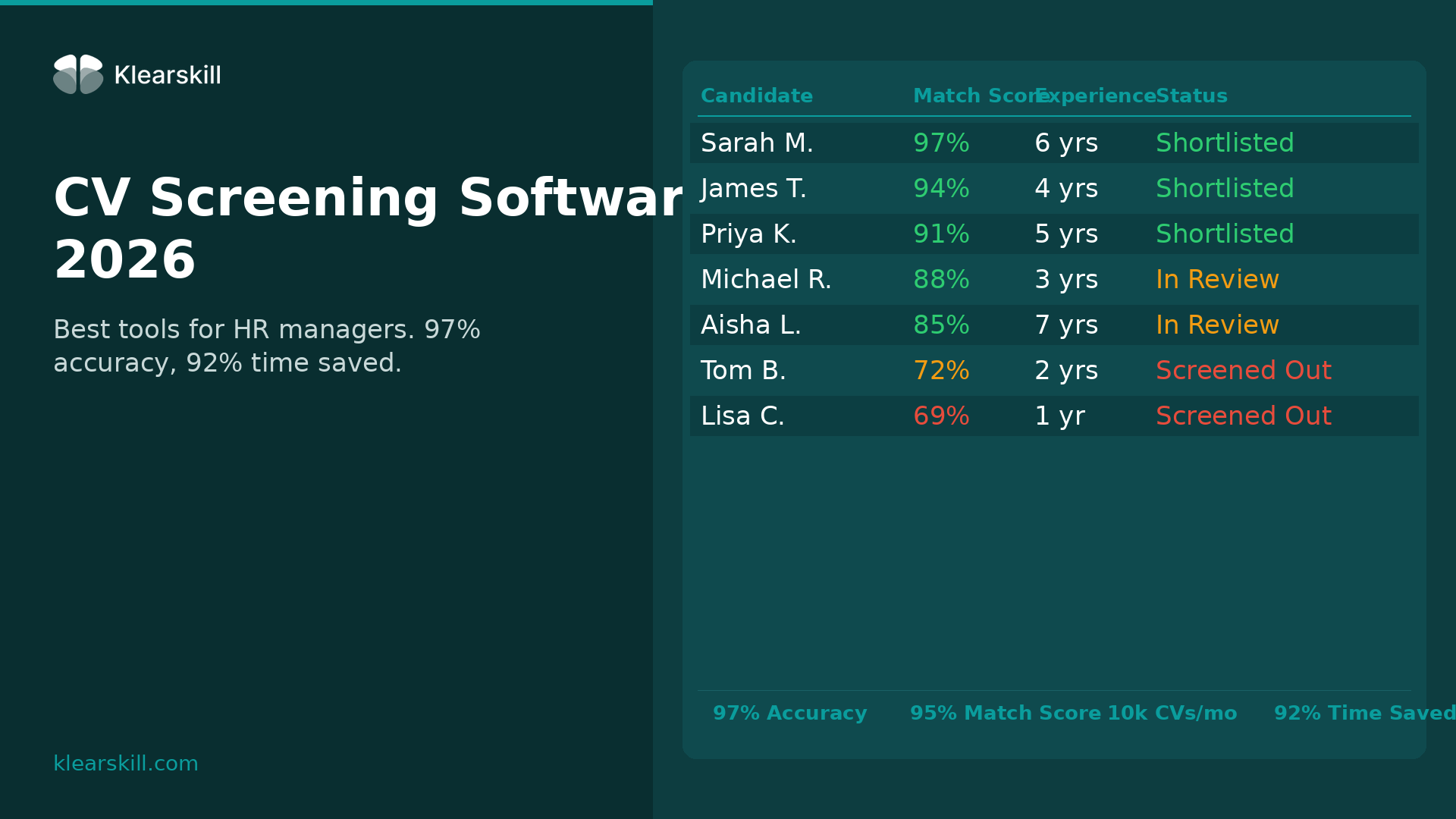
The workflow is simple by design. You upload or connect your CV source, configure your role criteria, and Klearskill scores and ranks every application automatically. The output is a clean ranked list with individual match scores and the criteria driving each score.
Hiring managers review the shortlist, can dig into individual scoring breakdowns, and progress candidates directly from within the platform. There is no need to export, reformat, or manage separate spreadsheets. The entire screening-to-shortlist process happens in one place.
Setup takes under an hour. There is no IT dependency, no lengthy onboarding, no professional services engagement required. You connect your job spec, set your scoring weights, and Klearskill is ready to process applications immediately.
CV Screening Software vs ATS: What Is the Difference?
Many HR managers encounter both terms and are unsure where one ends and the other begins. An Applicant Tracking System (ATS) is a workflow management tool: it tracks candidates through stages, manages communications, and maintains a hiring record. Most ATS platforms include some screening capability, but it is typically basic keyword matching.
Dedicated CV screening software focuses specifically on the quality of the selection decision. It is built to answer the question "which of these candidates is most likely to succeed in this role?" rather than just "has this candidate applied?" The two categories can overlap, and some platforms attempt to do both, but the best CV screening tools are those built specifically for the accuracy of the selection process.
Klearskill operates as a purpose-built screening platform that integrates with existing ATS workflows, giving teams the accuracy of a specialist tool without requiring them to replace their wider hiring infrastructure.
Frequently Asked Questions
How accurate is AI CV screening software in 2026?
Accuracy varies significantly between platforms. Basic keyword-matching tools typically perform at around 65-72%. More advanced AI platforms, including Klearskill, achieve 97% accuracy when scoring CVs against specific role criteria. The difference has a direct impact on shortlist quality and the risk of missing strong candidates.
Can CV screening software handle high application volumes?
Yes, purpose-built platforms are designed for scale. Klearskill processes up to 10,000 CVs per month without degradation in scoring quality, making it suitable for high-volume roles, graduate intake schemes, and businesses with multiple concurrent vacancies.
How long does it take to set up CV screening software?
Setup time varies considerably. Enterprise ATS platforms can take months to configure. Klearskill is operational in under an hour with no technical setup or IT support required, which makes it practical for businesses that need to move quickly.
What does CV screening software cost?
Pricing models range from per-user monthly fees to enterprise annual contracts. Klearskill charges $100 per month flat, regardless of the number of CVs processed or users accessing the platform. This makes costs predictable and affordable for SMEs and growing teams.
Does CV screening software work for all job types?
The best platforms are role-agnostic and allow you to configure scoring criteria specific to each vacancy. This means they work equally well for technical roles, customer-facing positions, management hires, and entry-level volume recruitment. Klearskill supports custom criteria configuration per role, so the scoring model reflects exactly what each position requires.


